TO: Interested Parties
FROM: Edith Jorge-Tuñón
Deputy Executive Director, RSLC
DATE: November 9, 2021
RE: We Told You So – How the RSLC Made Historic Gains In New Jersey
The final Real Clear Politics polling average in New Jersey had Phil Murphy leading Jack Ciattarelli by nearly eight points. How is it possible, then, that the incumbent governor was taken to the wire and that Republicans won eight targeted Assembly races, flipped six Assembly seats, and defeated two Democrat incumbents in the Senate, including ousting the Senate President who has held his post since 2010?
While Monmouth pollster Patrick Murray missed so badly on this election that he had to write an op-ed in the Star-Ledger to formally apologize, the Republican State Leadership Committee (RSLC) led the effort to secure historic wins in the Garden State based on data that proved to be deadly accurate. To channel our inner-New Jerseyan: We told you so!
The RSLC in mid-July sent a memo to its donors and the news media titled, “New Data Shows Encouraging Signs for New Jersey Republicans.” Although it was ignored by every single New Jersey media outlet except Save Jersey, the document’s conclusion was simple:
“The current political landscape in New Jersey provides us with a chance to make gains in both the Assembly and the state Senate this year. The only obstacle is garnering enough resources to take advantage of the opportunity. Our modeling makes clear that if we hold incumbent Democrat legislators accountable for their extreme agenda, then we have paths to success in these key battleground districts.”
The memo also broke down in detail the RSLC’s message testing in LD-2, LD-3 LD-8, LD-11, and LD-16, outlining a playbook that could allow Republicans to make gains in these districts if we had enough resources to do so.
By sticking to our data and rallying behind a diverse slate of talented candidates, the RSLC and its affiliated partners maximized the $850,000 it spent in the state to help state Republicans in New Jersey to their most successful legislative election in decades and give them new power to push back on Phil Murphy’s gubernatorial appointments.
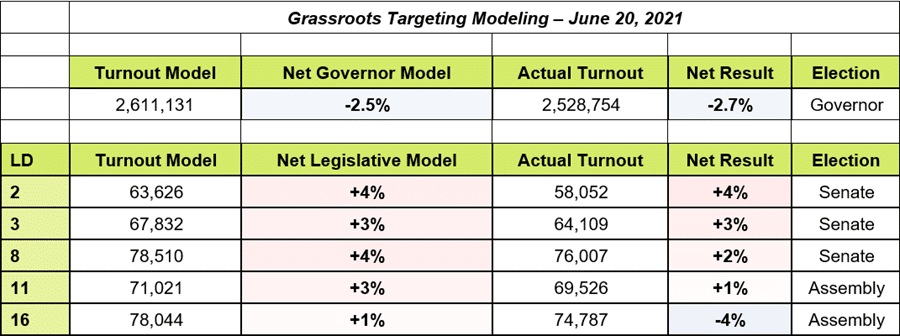
While we only stated in our memo published this summer that Phil Murphy was below 50%, our June model actually predicted the governor’s margin of victory to within 0.2%. We were just as accurate when it came to our target legislative races. Our data allowed us to correctly recognize before many others that, even though New Jersey is a blue state, the political environment was cutting against Democrats and running a campaign as a referendum against failed liberal leadership at multiple levels with targeted spending could be effective.
DATA-DRIVEN MESSAGING
In each of the districts where we flipped seats last week, the playbook was simple: remain laser-focused on the messaging that our June modeling showed would best resonate with persuadable voters. Here is a district by district refresher on what our data showed in June and how we executed paid media according to our findings.
LEGISLATIVE DISTRICT 2
From our July memo:
Paid Media Example:
LEGISLATIVE DISTRICT 8
From our July memo:
Paid Media Example:
The below mailer played on the message we tested that Addiego supported prioritizing illegal immigrants while New Jersey families were struggling financially.

LEGISLATIVE DISTRICT 11
From our July memo:
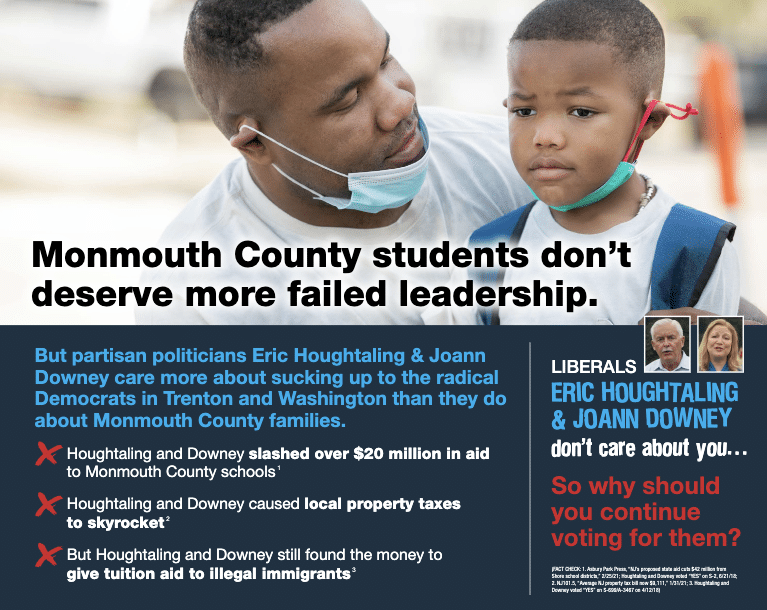
Paid Media Example: The below mailer held Houghtaling and Downey accountable on the issue of property taxes.
Not only did the RSLC deploy data-driven targeted spending in each of our target districts, we also helped recruit and train a diverse slate of candidates that were best suited to flip seats. This strategy was in line with the recent announcement of our Right Leaders Network, a redoubling of our long-standing efforts to grow the Republican Party with more women and minority candidates and elected officials.
While four out of seven of our Virginia House of Delegates flips were by women and minority candidates, our success in this area was even more profound in New Jersey.
LESSONS FROM LD-16 and LD-3
One district that we modeled back in June that looked like it had the potential to be competitive was LD-16. Republicans, however, did not pick up any Assembly seats in this district and failed to retain its open Senate seat. The reason? The RSLC decided not to fully invest in this district, as it was the weakest of the targets we discussed in our July memo.
While we maintain that this was the right decision based on the limited resources we had and our commitment to maximizing our gains in Virginia, we also believe the move speaks to the broader effectiveness of our efforts in New Jersey. We flipped legislative seats in every single one of our target districts where we spent significant resources, but lost in the one district we chose not to contest. This shows that the RSLC’s smart, targeted spending had a strong impact in the places we chose to spend, and that the only obstacle to making gains in similar left-leaning states in 2022 will be resources.
And while it may be pointed out that we did not spend significantly in LD-3, there was a strategic reason for that decision. We learned from the failed attempt by his own party to oust him in 2019 that directly running ads in the Senate President Sweeney’s district would be an expensive exercise that we could never afford. And given trends in South Jersey in recent cycles — such as Mike Testa and his team’s flip of LD-1 in 2019, as well as Jeff Van Drew’s party change and subsequent win in NJ-2 in 2020 — we believed that sleepy Assembly races in which we banked on the continued rightward movement of the political environment in LD-3 would be easier to win than if we turned them into high-stakes spending fights. Essentially, we felt our best way to contest LD-3 was to not target it at all. And while we never could have planned to oust Sweeney, it’s possible this strategy had a similar impact on him.
There are multiple conclusions that can be drawn from the historic success in New Jersey.
###
